

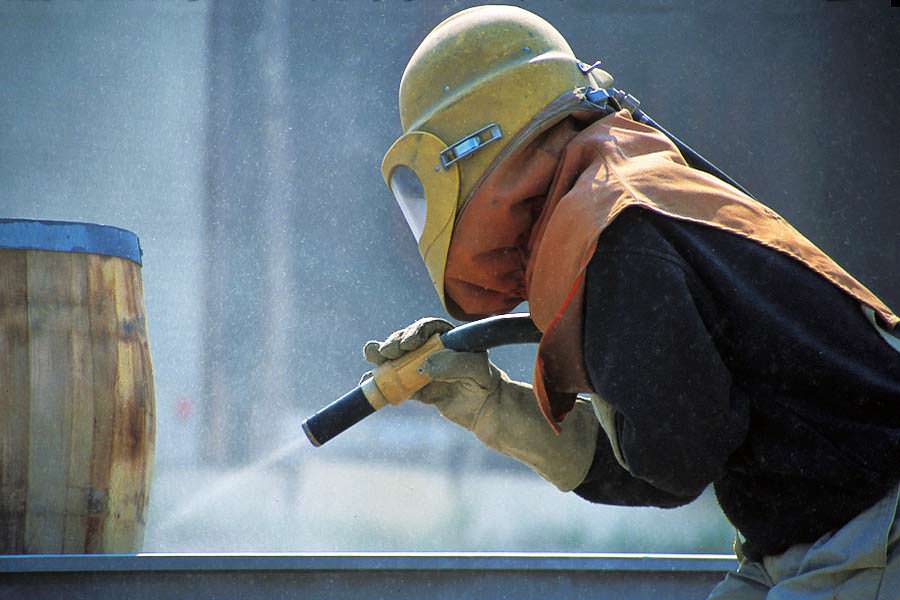
Sandblasting in Toronto is the surface preparation step that decides how long an industrial coating system will actually last. Before a single coat of primer goes on a plant ceiling, a storage silo, or a fleet of stamping presses, the steel or concrete underneath has to be stripped of rust, mill scale, and failed paint. Then it needs the right texture for the new coating to grip. Get that step right and the coating performs as its data sheet promises. Get it wrong and you pay for the same job twice.
People Also Ask
1. How much does sandblasting cost in Toronto?
Pricing depends on surface area, the condition of the existing coating, access, containment needs, and the cleanliness grade specified. Most sandblasting contractors quote after a site visit rather than pricing per square foot without seeing the job.
2. Is sand still used for sandblasting in Ontario?
Rarely. Silica sand has largely been replaced by mineral slags, garnet, crushed glass, and steel grit, which reduce silica exposure and do the same cleaning work.
3. Can sandblasting be done while a facility stays open?
Often, yes. With proper enclosures, dust collection, and phased work zones or off-shift scheduling, blasting can run alongside normal operations in many plants and warehouses.
For facility managers, maintenance leads, and plant engineers, the challenge is rarely deciding whether to blast. It is knowing what a proper job looks like, so they can write a clear scope, compare quotes fairly, and hold a contractor accountable. The terms on a coating specification (SP 10, Sa 2½, 2–3 mil profile) mean little until someone explains what they look like on your steel.
This guide walks through what industrial sandblasting services involve in a Toronto-area facility. It covers which assets can be treated, how media is chosen, what the cleanliness and profile standards mean, how dust and silica are controlled under Ontario rules, and how to compare sandblasting companies before you award the work.
What Industrial Sandblasting Involves
Industrial sandblasting is the process of propelling abrasive particles at high velocity against a surface to remove contaminants and cut a controlled texture into it. In a mobile setup, a large diesel compressor feeds air through moisture separators into a pressurized blast pot, which meters abrasive into a hose. The operator directs the stream through a nozzle, usually at 90 to 110 psi, and works the surface in overlapping passes.
The name is a leftover. Very little blasting in Ontario uses sand today, and “abrasive blasting” is the more accurate term. Most buyers still search for sandblasting services, though, so the industry uses both.
Every blast job has two goals that happen at the same time:
- Cleaning, which means removing rust, mill scale, old coatings, and surface contamination down to the grade the specification calls for.
- Profiling, which means leaving a pattern of peaks and valleys that the new coating can mechanically lock into.
A surface can be clean without being properly profiled, and the reverse is also true.
Dry abrasive blasting is the workhorse for structural steel and tanks. Wet blasting adds water to knock down dust, but the water causes flash rust, so an inhibitor has to be used. Shot blasting uses a walk-behind machine that throws steel shot and reuses it. That makes it the standard prep for epoxy floor coatings.
Pressure washing and dry ice blasting are sometimes offered as alternatives, but neither leaves a profile. When a coating needs to bond to bare steel, abrasive blasting is usually the only method that meets the specification.
Surfaces and Assets a Blasting Crew Can Treat
A mobile blasting crew can treat nearly any steel or concrete asset that can be reached safely.
In manufacturing plants, the most common work includes:
- Structural steel, including columns, trusses, joists, and deck undersides where old paint is peeling onto production lines.
- Machinery and equipment such as presses, conveyors, and hoppers, often blasted in place.
- Process piping, pipe racks, and platforms.
- Storage tanks, silos, and pressure vessels, inside and out.
Plastic production plants often need silos and conveying systems cleaned of resin buildup and corrosion. Metal fabrication and automotive plants tend to have long runs of ceiling steel and heavy equipment. Oil and gas facilities have tank farms and piping, where a coating failure costs more.
Commercial properties have a different mix. Parking garages under condo, apartment, and office buildings need concrete blasted before protective coatings go down. Warehouses often have vast ceilings that need stripping before repainting. Metal building exteriors can be blasted when the finish has failed too badly for a scuff-and-paint approach.
On concrete floors, blasting removes laitance and failed coatings so epoxy floor coatings bond to sound material. Steel that will receive intumescent fireproof coatings typically needs a blasted surface under a compatible primer.
Some assets need extra caution. Thin-gauge sheet metal can warp under aggressive blasting. Machinery with bearings, seals, or electrical panels has to be masked thoroughly, because abrasive finds every gap.
How Contractors Match Blast Media to Your Substrate
Blast media is chosen by working backward from the coating specification. The contractor looks at the substrate, the profile required, the containment setup, and whether the media can be reused. Then they pick the abrasive that reaches the target most efficiently.
The main options used by sandblasting contractors in Ontario include:
- Mineral slags (coal slag and copper slag). These are angular, fast-cutting abrasives that are used once and discarded. They are common on tanks, structural steel, and exterior work.
- Garnet. It is hard, low-dusting, and cuts a consistent profile. Crews often prefer it indoors, where visibility and cleanup matter.
- Crushed glass. It contains no crystalline silica and leaves a bright finish on steel, but it breaks down faster than harder media.
- Steel grit and steel shot. Grit cuts a sharp profile, while shot peens the surface. Both can be reused many times inside full containment or in shot-blasting machines.
- Soft media such as plastic, glass bead, and walnut shell. These strip coatings from precision components without changing the substrate.
Particle shape and size matter as much as the material. Angular grit leaves a sharp profile that suits most high-build epoxy systems. Coarser particles cut deeper, while finer mesh gives a shallower, more uniform pattern.
Here is how that plays out on real assets. A rusted carbon steel silo with a 2 to 3 mil target will usually get slag or garnet for cutting power. Stainless steel equipment should not be blasted with carbon steel grit, which can embed iron particles that later rust, so a non-ferrous abrasive is the safer call. Price per tonne can also mislead. The cheapest abrasive can cost more on the job if it dusts heavily or breaks down fast.
What Blast Cleanliness Grades Mean for Your Coating
A blast cleanliness grade defines how much rust, mill scale, and old coating may remain on the steel after blasting. The coating system sets the grade, not the contractor, and it is the most important line in any sandblasting scope.
Specifications in Canada usually cite the SSPC/NACE standards, now maintained by AMPP, or the ISO 8501-1 equivalents:
- White Metal Blast Cleaning (SSPC-SP 5 / NACE No. 1, ISO Sa 3). The steel is completely free of visible rust, mill scale, paint, and staining. This grade is reserved for severe service such as tank linings and immersion.
- Near-White Metal Blast Cleaning (SSPC-SP 10 / NACE No. 2, ISO Sa 2½). Light shadows or streaks are allowed on no more than 5 percent of each unit area. This is the most common grade for high-performance epoxy systems in industrial environments.
- Commercial Blast Cleaning (SSPC-SP 6 / NACE No. 3, ISO Sa 2). Staining is allowed on up to 33 percent of each unit area. This grade suits many atmospheric exposures such as structural steel and exteriors.
- Industrial Blast Cleaning (SSPC-SP 14 / NACE No. 8). Tightly adhered mill scale, rust, and coating may remain on up to 10 percent of each unit area. This is a practical middle ground for maintenance painting.
- Brush-Off Blast Cleaning (SSPC-SP 7 / NACE No. 4, ISO Sa 1). Loose material is removed, and tightly adhered material stays. It is used to roughen sound existing coatings or galvanizing before overcoating.
Each step up the scale takes more time and abrasive. If the coating only needs SP 6, specifying SP 5 wastes money. If it needs SP 10 and gets SP 6, the coating warranty may not hold.
Soluble salts catch many buyers off guard. Chlorides from road salt or chemical exposure sit invisibly in pits and survive dry blasting. Under a new coating, they cause blistering. Where that exposure is likely, salt testing and washing belong in the scope.
Ask for the grade to be checked against SSPC-VIS 1 or ISO 8501-1 reference photographs and recorded in writing. A quick visual glance is not enough.
Surface Profile and Why Coating Life Depends on It
Surface profile is the depth of the peaks and valleys the abrasive cuts into the steel, measured from the bottom of the valleys to the top of the peaks. It is expressed in mils (thousandths of an inch) or microns, where 1 mil equals about 25 microns. Coating adhesion depends on it directly.
A smooth surface gives the coating nothing to grip, so thermal cycling, impact, or moisture can peel it away. A proper profile increases surface area and gives the coating a mechanical anchor.
Most coating data sheets specify a range rather than a single number. Many industrial epoxy primers call for something in the 1.5 to 3 mil range, while thick-film linings may need 3 to 4 mils or more. Induspray’s crews can achieve profiles from 0.5 mils to 5 mils deep, which covers the range most industrial systems require.
Both ends of the range carry risk:
- A profile that is too shallow reduces adhesion. It can lead to delamination, particularly with high-build coatings that shrink as they cure.
- A profile that is too deep leaves rogue peaks that poke through thin primer films. Those peaks become pinpoint rust spots within a season or two, and the only fix is to strip and redo the area.
Profile is measured on site under ASTM D4417. Crews most often use a depth micrometer or replica tape, and the tape leaves a physical record for the daily report.
Concrete uses a different scale. The ICRI Concrete Surface Profile (CSP) scale runs from CSP 1, which is nearly flat, to CSP 10, which is very rough. Thin epoxy floor coatings need a lighter profile than thick trowelled systems.
Make sure your scope names a profile range and requires readings at a set frequency. Without that, you have no objective way to check the work before it gets covered.
What Happens Before Blasting Starts
Most of what separates a smooth blasting job from a messy one happens before the compressor starts. A well-run pre-blast phase usually covers the steps below.
Site assessment and specification review. The contractor walks the site and confirms the cleanliness grade, profile range, and coating system. If no specification exists, they help build one.
Hazardous material testing. Older steel in Toronto-area plants often carries lead-based paint, and some older coatings or nearby materials may contain asbestos. Samples should be tested before blasting, because the results change the containment design, worker protection, and how spent abrasive is disposed of. Under Ontario’s Occupational Health and Safety Act, project owners are expected to identify designated substances on a project and disclose them to bidders.
Pre-cleaning. Oil, grease, and heavy residues must be removed before blasting, typically by solvent or detergent cleaning to SSPC-SP 1. Blasting over grease does not remove it. It smears the contamination across the surface and into the abrasive, which can cause the coating to fail over a much wider area.
Salt testing and washing. Where the specification requires it, crews test for chlorides and wash the steel with clean water or a salt-removal solution before blasting.
Protection and masking. Motors, control panels, sprinkler heads, and anything else that must not be blasted get masked or bagged. Nearby HVAC intakes are sealed.
Safety planning. Lockout, confined-space permits, and fall protection are settled in advance and matched to the facility’s own permit system.
Logistics. Compressor placement, hose routing, media delivery, and waste bins are agreed with the facility team. A badly placed media drop can block a shipping door for a week.
How Containment and Dust Control Are Handled On Site
Containment is the system of barriers, ventilation, and cleanup methods that keeps abrasive and removed coating inside the work zone. How much containment a job needs depends on what is being removed, where the work is happening, and who else is nearby.
Indoors, crews enclose the work area with reinforced tarps on a frame. A dust collector holds the enclosure under negative pressure, so air is pulled in rather than dust pushed out. Large ceilings are often split into zones and blasted one at a time while production continues elsewhere.
Outdoors, containment ranges from wind screens and ground tarps for lower-risk work to full enclosures around tanks or structures. Full enclosures are used when lead paint is present or when the site borders other businesses, parking areas, or roads. Where others may be exposed during outdoor blasting, Ontario’s guidance for silica on construction projects recommends marking off the area with ropes or barriers at least 25 metres from the blasting.
Beyond the barrier, dust control relies on properly sized dust collectors and on low-dusting abrasives or wet blasting in sensitive areas. Cleanup should use HEPA vacuums or wet methods instead of dry sweeping or compressed air.
If testing shows lead or other heavy metals in the old coating, spent media may need to be managed as hazardous waste under Ontario’s waste regulations. Ask who arranges disposal and whether it is included in the quote.
Sensitive electronics, finished inventory, and packaging lines near the work zone may need extra sealing or relocation. Raise these during the site walk.
What Ontario Silica Rules Require From Your Contractor
Crystalline silica is a designated substance in Ontario, and abrasive blasting is one of the tasks most likely to put harmful silica dust in the air. Your contractor needs documented procedures to protect workers from it, whether the silica comes from the abrasive or from the surface being blasted.
O. Reg. 490/09, the Designated Substances Regulation, sets exposure limits of 0.10 mg/m³ for quartz and 0.05 mg/m³ for cristobalite. On construction projects, which include most contracted blasting, those limits do not apply directly. Employers still carry a general duty under the Occupational Health and Safety Act to protect workers.
The Ministry’s guideline, Silica on Construction Projects, is the reference most inspectors and contractors work from. It sorts silica-generating tasks into Type 1, 2, and 3 operations by exposure risk. Abrasive blasting falls in the highest category, Type 3, when either of these is true:
- The abrasive contains 1 percent or more silica.
- The material being blasted contains 1 percent or more silica.
That second point is easy to miss. Concrete, brick, and mortar all contain silica. So blasting a parking garage deck or a plant floor is a high-risk silica operation even when the abrasive itself is silica-free.
For Type 3 blasting, the guideline sets out several measures:
- The nozzle operator wears a Type CE abrasive-blast supplied-air respirator operated in pressure-demand or positive-pressure mode.
- Compressed air feeding supplied-air respirators should meet the breathing air purity requirements of CSA Z180.1. A continuous carbon monoxide monitor is recommended when an oil-lubricated compressor supplies the air.
- Workers who enter the blast area for more than 15 minutes wear respirators with an assigned protection factor of 50. Shorter entries for inspection still require a particulate respirator.
- Where others could be exposed, indoor blasting is separated from the rest of the project by an enclosure, and warning signs restrict access to authorized people.
- Cleanup uses HEPA vacuuming or wet methods rather than dry sweeping.
Owners have an obligation too. Section 30 of the Act requires a project owner to determine whether designated substances such as silica are present and to disclose them to bidding contractors.
When evaluating sandblasting contractors, ask to see:
- Their written silica exposure control procedures.
- Their respiratory protection program, including fit testing and training records. In Ontario, these programs are typically built around CSA Z94.4.
- Details of their supplied-air systems and breathing air monitoring.
A contractor who has to go looking for these documents puts your schedule at risk if an inspector shows up.
Access, Scheduling, and Production Impact
Access, timing, and disruption drive a large share of the cost and risk on any blasting project. Planning them early keeps surprises away from the production team.
Ceiling steel may be reached with scissor or boom lifts, and congested areas over equipment may need scaffolding. Tank interiors require confined-space entry with attendants and atmospheric testing. Crews working at height in Ontario need Work at Heights training. Ask who supplies the access equipment and whether it is priced in.
Scheduling follows from access and from the facility’s operating pattern. Common approaches include:
- Planned shutdowns, where blasting and coating are packed into a maintenance window.
- Off-shift work, running nights and weekends when production is down or reduced.
- Phased zones, where one section of a building is enclosed and blasted while the rest keeps running.
- Multiple crews or shifts, which compress the timeline on large areas.
Induspray’s own project experience gives a sense of scale. A single silo can be abrasive blasted in as little as one day, depending on height and access. An empty 150,000 sq ft warehouse with peeling ceilings could take two to three weeks, depending on how many crews and shifts are assigned.
Blasting and coating have to be scheduled together. Freshly blasted steel starts to flash rust within hours. Crews should only blast what can be primed within the same shift, and the steel should stay at least 3°C (5°F) above the dew point. A contractor who blasts a whole structure and plans to prime next week is setting up rework.
Expect relocated inventory, covered equipment, cordoned aisles, noise, and restricted forklift routes near the work zone. Short daily check-ins with the facility supervisor keep everyone clear on which zones are active. One Induspray client noted that four large stamping presses were painted with minimal disruption to production. That kind of result comes from detailed sequencing.
How to Compare Sandblasting Companies Before Awarding Work
The best way to compare sandblasting companies is to have every bidder price the same clearly defined scope. Then judge them on how well they plan, protect, and document the work, not only on price.
Start with the scope itself. Your request for quotation should state:
- The assets and areas to be blasted, with approximate square footage or drawings.
- The required cleanliness grade (for example, SSPC-SP 10).
- The profile range from the coating data sheet.
- The coating system to follow, if the same contractor is applying it.
- Known hazardous materials, including silica-containing substrates and any lead paint.
- Access constraints, operating hours, and areas that must stay in production.
With that in hand, compare bids on these points:
- Method and media. Does the bid name the abrasive and explain why it suits your substrate and containment setup?
- Containment and dust control. Does the bid describe the enclosure, dust collection, and cleanup method, or just say “containment as required”?
- Silica and designated substance procedures. Can they produce written procedures, respirator program records, and training documentation?
- Crew qualifications. Look for Work at Heights, aerial work platform, WHMIS, and confined-space training. All Induspray painters are certified, licensed, and fully insured, and that is a fair baseline to ask of any bidder.
- Insurance and WSIB. Request a current certificate of insurance naming your company and a WSIB clearance certificate.
- Quality control. Will profile readings, cleanliness checks, and environmental readings be recorded and shared? Are there hold points for inspection before coating, or third-party coating inspection where the project warrants it?
- Waste handling. Who tests and disposes of spent abrasive, and is it priced in?
- References. Ask for projects in similar facilities rather than general testimonials.
Awarding blasting and coating to one contractor closes the gap between trades where flash rust forms. It also means no one else to blame if the coating fails.
Watch for red flags too. These include a quote that says “sandblast and paint” with no grade or profile, a per-square-foot price given without seeing the steel, and silence about silica and lead on an older facility. The lowest bid can still be the right one, as long as it covers the same work to the same standard.
Planning Your Next Sandblasting Project in Toronto
Sandblasting in Toronto facilities is a controlled process driven by the specification. Once you know the standards, you know what to expect. The right contractor confirms the cleanliness grade and profile before starting and chooses media to suit your substrate. They contain dust and silica to Ontario requirements, schedule around your production, and document the results before the coating goes on.
Induspray has provided sandblasting services in Toronto and across Ontario since 1975. Our crews prepare structural steel, silos, tanks, machinery, and concrete for high-performance coating systems. They are certified, licensed, and fully insured. We handle both the surface preparation and the coating, so one team is accountable for the finished result.
If you are planning blasting or repainting work at your plant, warehouse, parking garage, or energy facility, call 416-422-3020 or request a quote. We will assess the site and recommend a scope that fits your coating system and your schedule.
Frequently Asked Questions
What blast grade do most industrial coatings require?
Many high-performance epoxy systems call for near-white metal (SSPC-SP 10), while atmospheric steel often needs commercial grade (SSPC-SP 6). The coating data sheet sets the requirement.
Can sandblasting remove lead paint?
Yes, but lead paint requires testing first, full containment, stricter worker protection, and proper handling of spent abrasives as potentially hazardous waste.
Is shot blasting the same as sandblasting?
Shot blasting is a type of abrasive blasting that uses a machine to throw reusable steel shot, mainly on concrete floors before epoxy floor coatings.
Do I need to empty my building before sandblasting?
Not usually. Most facilities stay partly operational, with work zones enclosed and nearby equipment and inventory covered or moved.


